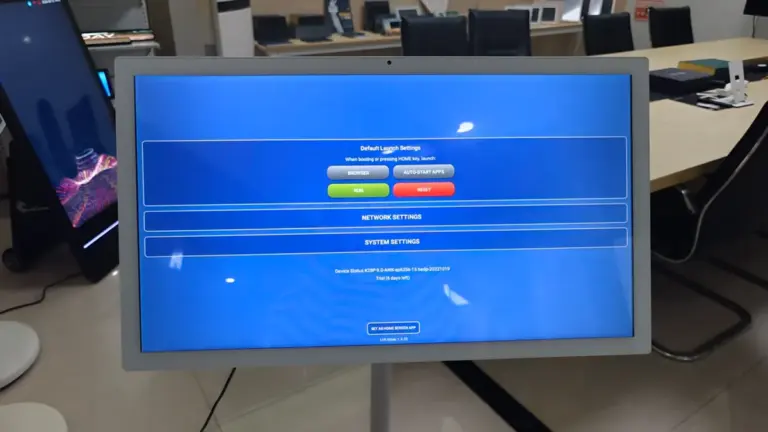
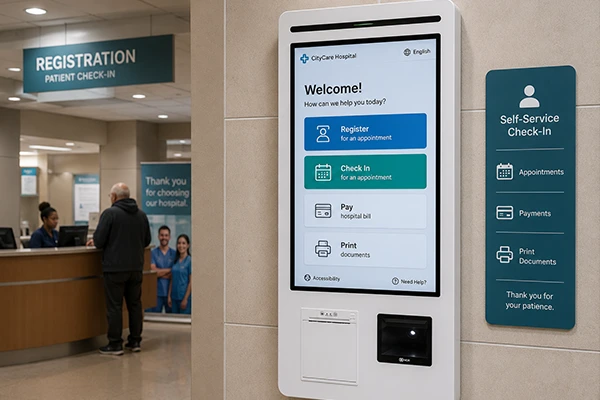
In self-service kiosk projects, the manufacturer decision is the project decision. The hardware you are buying runs unattended in public space for years, carries your brand’s face at the moment of transaction, and needs to survive software updates, payment certification cycles, and spare-parts logistics long after the first shipment. A kiosk program with the wrong factory behind it does not fail at ordering — it fails at month nine, when a batch fault appears and the “manufacturer” turns out to be a trading company that cannot open the production line that built your units.
This guide lays out what experienced procurement teams check when vetting a self-service kiosk manufacturer: the factory-or-middleman question, the production and testing evidence worth demanding, platform and customization capability, commercial transparency, and after-sales discipline. It is written for procurement directors and supply chain managers vetting kiosk manufacturers for OEM partnerships. If you are earlier in the process and still defining the hardware itself, our guide to factors to check when choosing commercial touch displays covers that stage.
Key Takeaways
- Establish who actually builds the product: a manufacturer with in-house SMT, SOP-driven assembly lines, and an aging room can trace and fix issues; a reseller can only forward your emails.
- Demand testing evidence, not testing claims — ISO 9001 for the process system, CE/FCC/RoHS for product compliance, and a mandatory 24-hour burn-in on every unit for field reliability.
- Measure the platform, not the sample: OS breadth (Android/Windows/Linux), peripheral integration as factory options, documented APIs, and customization tiers with honest lead times.
- Make commercial transparency a gating criterion — production pricing stated at the sample stage with a validity period, no-MOU standard orders, and clear incoterm and payment structure.
- Stress-test after-sales before you need it: warranty scope, 24-hour response, remote diagnosis first, direct-shipped parts with video guides, and spare-parts ratios on bulk OEM orders.
Manufacturer or Middleman: Settle This First
The kiosk supply market has three layers: factories that design and build, trading companies that buy and resell, and hybrid assemblers who bolt together purchased modules without controlling the platform. All three send attractive quotations; only the first can carry an OEM partnership. The distinction matters at every stage that follows — a real manufacturer can modify the mainboard firmware, open the aging room for your audit, lock component pricing upstream, and engineer a fix when a field fault appears. Everyone else must ask someone else.
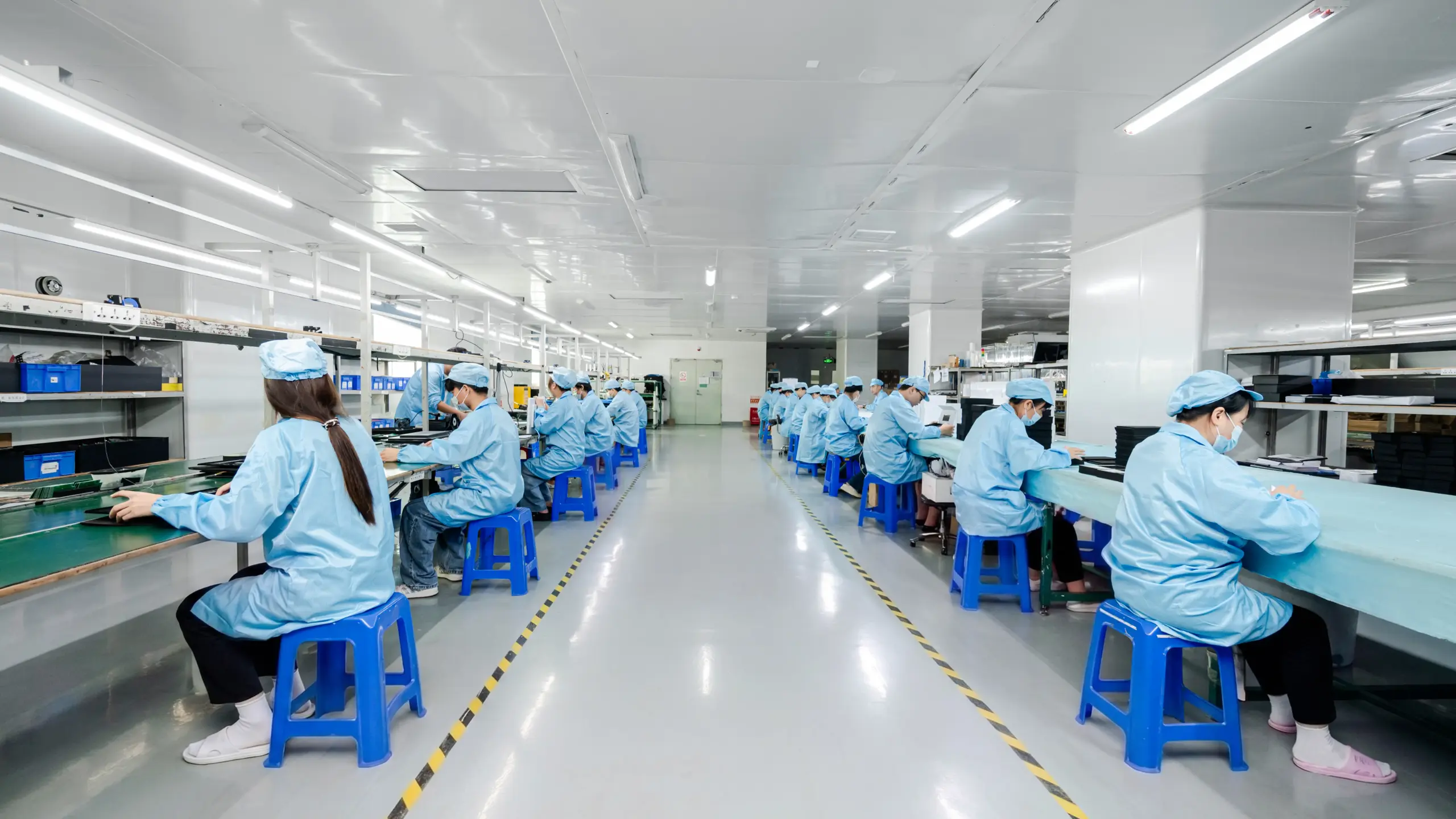
Practical verification is straightforward. Ask for the factory address and production floor documentation — a manufacturer states them plainly; ask for photos or video of the SMT lines, assembly stations, and aging room, and expect them to match the documentation; ask who holds the product certifications and whether engineering questions go to an in-house team. Factories with nothing to hide answer in hours. Levinko, for example, operates a 3,000 m² Shenzhen facility with in-house SMT and standardized assembly — the manufacturing overview E company profile exist precisely so buyers can verify this layer before engaging.
Factory Depth: The Evidence Worth Demanding
“Factory” is not a binary badge — depth varies, and depth is what you are relying on when something goes wrong in year two. Structure your vetting around four evidence points:
| Evidence Point | What to Ask For | What It Proves |
|---|---|---|
| Production system | ISO 9001 certificate, SOP documentation per station, production floor records | Quality is a repeatable process, not a good batch |
| Board-level control | In-house SMT lines, PCBA inspection steps, mainboard documentation | Fault tracing to station and lot; firmware fixes are possible |
| Reliability testing | Aging-room photos/video, the burn-in policy (every unit, 24 hours), reject-rate handling | Infant-mortality failures happen at the factory, not at your sites |
| Capacity & scale | Facility size, monthly output, current program load | Your rollout volume fits the production rhythm |

Two behaviors reliably expose shallow factories during this stage. Primo, inability to connect a spec question to a production answer — ask how the IP65 front-panel seal is achieved and inspected, or how the watchdog timer is implemented on the mainboard; manufacturers answer with process detail, resellers answer with adjectives. Second, refusal of pilot access — a factory running real processes welcomes a sample order and a video walkthrough, because that is its cheapest sales tool.
Platform Breadth and Customization Capability
A reliable kiosk manufacturer sells a platform, not a product. Judge breadth on three axes. OS coverage: the same kiosk family should be orderable in Android, Finestre (fanless through Core i-series), e Linux, so your software chooses the platform — a factory locked to one OS is telling you about its supply chain, not your options. Form factor range: floor-standing, desktop, and wall-mounted variants on shared internals — like the PR-series floor-standing kiosks and their desktop and wall-mounted siblings in the self-order and payment kiosk category — keeps multi-position fleets on one spares and integration base. Peripheral integration: stampanti, scanner, NFC/RFID readers, and payment-terminal bays as factory options with documented driver and API support, not as your integration project.
Then judge customization honestly, because OEM programs live or die on it. The professional structure is tiered: white-label customization (logo silk-print, packaging, boot screen, app preload) that ships almost as fast as standard product; light customization (Pantone colors, materiali, interface changes) with samples in 7–10 days; and deep customization (board-level development, new structures and molds, certification cooperation) with 30–35 days to samples. A manufacturer who describes all three tiers with concrete lead times is describing a factory; one who promises “anything you want, immediately” is describing a sales pitch. What each tier can cover in practice is detailed in our coverage of custom touch display options for OEM projects and the OEM and ODM services program.
Quality System: Testing and Certifications
Certifications qualify the manufacturer; testing protects your deployment — vet them as separate items. On certifications: ISO 9001 on the factory, CE/FCC/RoHS on the products as standard, and — decisive for American and British buyers — the ability to run UL and UKCA as cooperation projects rather than a shrug. On testing: the non-negotiable is a mandatory 24-hour burn-in on every unit before shipment, backed by functional testing of every interface and peripheral, panel-grade inspection (A-grade IPS policy, dead-pixel and uniformity checks), and pre-shipment configuration so units arrive in deployment state. Ask what happens to rejected units; rework discipline is where a quality system shows itself.
The acid test combines both: ask the candidate to demonstrate watchdog auto-recovery on a sample unit — force the application to hang and watch the hardware restart it automatically (on Levinko platforms, within roughly 50 secondi). A manufacturer whose engineering team can stage that demonstration in an afternoon has the test culture your fleet will depend on; one that needs “to check with the factory” has answered a different question.
Commercial Transparency and Terms
Reliability has a commercial dimension: the manufacturer who prices honestly is the manufacturer you can still work with when volumes scale. Screen candidates on four practices. Sample-stage production pricing — a professional supplier states the bulk price range for your specification when you order samples, with an explicit validity period, and locks pricing for committed volume; the industry’s classic trap is the low sample quote followed by a bulk-stage increase once you are committed. Order flexibility — standard and white-label products without minimum order quantities, so your pilot is a purchase order, not a negotiation. Clear terms — standard OEM/ODM payment structure (typically 30% deposit, 70% balance) stated without games. Incoterm fluency — EXW as the default, FOB Shenzhen for container programs, and DDP when you want the manufacturer to run the door-to-door logistics; a factory that handles all three smoothly is telling you it ships internationally every day.
After-Sales and RMA Discipline
Every kiosk fleet will need support; the question is whether support is a process or an email address. The professional pattern looks like this: a one-year warranty as standard; a 24-hour response commitment with engineers (not just sales staff) on the reply; remote diagnosis as the first step — video calls, logs, and guided checks that resolve most issues without shipping anything; parts logistics designed for speed — replacement boards and components direct-shipped with video replacement guides, so a field fix is a screwdriver job rather than a return shipment; and spare-parts ratios negotiated into bulk OEM orders, so your technicians hold the parts before failures happen. Evaluate this before ordering by testing the response path with pre-sales technical questions: the speed and engineering quality of the answers you get while they are still courting you is the best-case version of the support you will get after they have you.
Red Flags That Should End the Evaluation
- No verifiable factory — no address, no floor documentation, no aging-room evidence, O “factory visit later.” Later never comes; end it now.
- Testing described in adjectives — “strict quality control” with no burn-in policy, no reject-rate answer, no demonstration of watchdog recovery.
- One-OS fundamentalism — the platform is Android-only or Windows-only “because that’s what we do,” with your software requirements fitted around it.
- Pricing opacity at sample stage — sample quotes without production pricing or validity periods, which is the setup for bulk-stage increases.
- No documentation trail — no API or SDK docs, no interface specifications, no dimensional drawings. Integration debt starts here and compounds forever.
Running the Vetting Process in Practice
Sequence the evaluation as a funnel. Primo, paper screening: collect the factory evidence, certificazioni, platform documentation, and terms above from three to five candidates, and disqualify on red flags immediately. Second, technical deep-dive with the two or three survivors: put your transaction script, peripheral list, and software stack in front of their engineers and judge the specificity of the answers. Third, pilot: order one or two units at production specification, run your application, and test the failure paths — network loss, application hang, power cut — plus the watchdog demonstration. Fourth, negotiate the program: pricing with validity, customization tiers with lead times, spare-parts ratio, and the RMA process in writing. A manufacturer that passes all four stages with you is a partner; one that passes only the quotation stage is a risk with a delivery date. To see what a complete factory-grade kiosk program looks like as a reference point — from the production floor through platform, customization, and support — review the self-service payment kiosk manufacturer program at Levinko, and the support process that stands behind deployed fleets.
Domande frequenti
How can I tell if a kiosk supplier is a real manufacturer?
Ask for verifiable production evidence and check the specificity of the answers: factory address and floor documentation, photos or video of in-house SMT lines and assembly stations, an aging room you can see, ISO 9001 in the company’s name, and engineering answers to technical questions (sealing, watchdog implementation, firmware) that include process detail. Manufacturers answer in hours with specifics; resellers forward emails and return adjectives. A pilot order plus a live watchdog-recovery demonstration settles any remaining doubt.
What certifications should a self-service kiosk manufacturer hold?
Two layers. The factory should hold ISO 9001 — evidence that quality is a managed, repeatable process. The products should carry CE, FCC, and RoHS as standard for the markets they serve; for North America and the United Kingdom, look for the ability to run UL and UKCA as cooperation projects rather than a refusal. Remember that certifications qualify design and process — they do not replace unit-level testing like the 24-hour burn-in, which you should verify separately.
What is the smartest way to verify quality before committing?
A pilot order with deliberate failure testing. Order one or two units at production specification, load your real application, and run them at a real position. Then break things: disconnect the network, force the application to hang and watch the watchdog restart it, cut power and confirm auto-start recovery. Request the aging-room evidence for your batch. Two weeks of that tells you more than any audit visit, and a manufacturer who resists being tested this way has told you the most important thing about them.
Do kiosk manufacturers require minimum order quantities?
Professional manufacturers do not set MOQ on standard and white-label products — one pilot unit is a normal order, because sampling is how B2B programs start. Volume expectations attach to customization depth: interface and material changes amortize across real quantities, and board-level or mold-level development is scoped individually. Be more suspicious of a supplier with no MOQ and no sample-stage production pricing than of either policy alone — the combination is the classic low-sample-price, high-bulk-price setup.
What after-sales support should I demand from a kiosk manufacturer?
A process, not a contact: a one-year standard warranty; 24-hour response with engineers on the reply; remote diagnosis as the first resolution step; direct shipment of replacement boards and parts with video replacement guides so field fixes are local screwdriver work; and a negotiated spare-parts ratio included with bulk OEM orders so your team holds parts before failures occur. Test the response path during evaluation — pre-sales engineering support is the best support you will ever receive from that supplier.