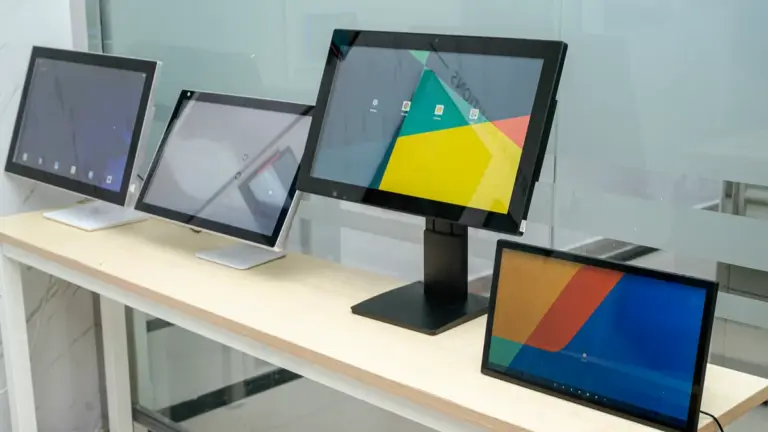
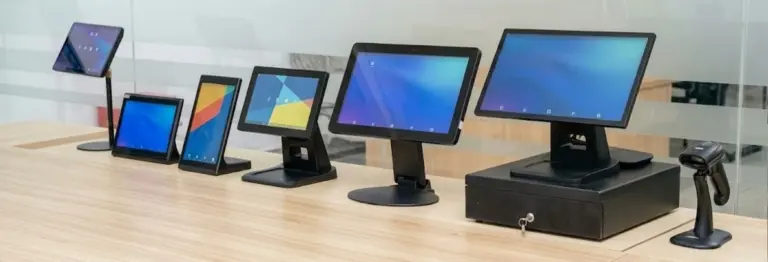
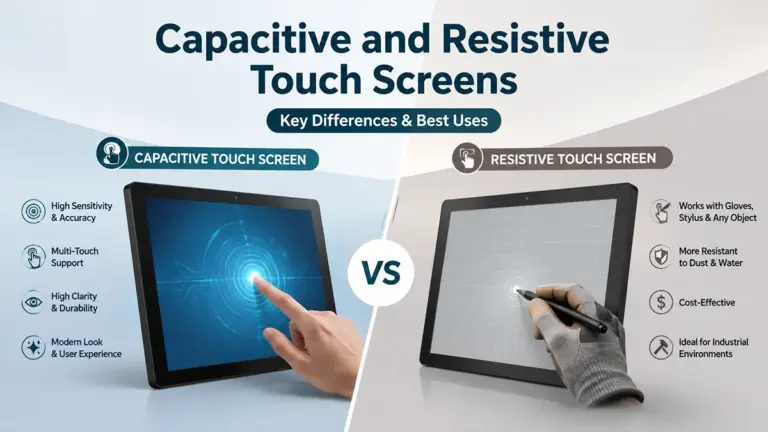
Choosing a touch screen monitor is a product decision; choosing who builds it is a business decision. The manufacturer determines whether your second order matches your first, whether engineering questions get answered in a day or a week, and whether a hardware problem in the field becomes a couriered spare part or a six-week argument. For OEM programs and multi-site commercial deployments, supplier capability ends up mattering more than any single unit’s spec sheet.
This guide lays out how B2B buyers — brand owners, system integrators, and procurement teams — should evaluate a touch screen monitor manufacturer before committing a project. Each section gives concrete evidence to request and red flags to watch for, so the evaluation produces a decision rather than a feeling.
Key Takeaways
- Evaluate factories, not websites: in-house SMT lines, assembly, and aging tests predict consistency better than any catalog claim.
- Ask for documented engineering support — pin maps, driver packages, API/SDK documentation — as a scored requirement, not a favor.
- ISO 9001 certification for the factory plus CE/FCC/RoHS product certificates (with UL/UKCA support experience) form the compliance baseline.
- Transparent mass-production pricing at the sample stage separates professional manufacturers from those who win on samples and recoup on volume.
- A platform approach — shared mainboards, واجهات, and APIs across screen sizes — protects your software investment as the deployment grows.
Why Manufacturer Choice Outweighs Unit Price
Touch monitor deployments are bought once and lived with for years. Over that lifetime, the costs that dominate are the ones the unit price hides: failed units pulled from service, integration hours burned on undocumented behavior, project delays while replacements ship, and the price drift between the sample order and the volume order. A supplier who is stable, transparent, and engineering-capable reduces every one of those risks; a cheaper supplier who is not, multiplies them.
The evaluation that follows mirrors how professional OEM buyers qualify factories. Run it deliberately, score it in writing, and weight the sections that match your project reality — an unattended kiosk network weights reliability and support; a branded product line weights customization and certification; a fleet of room panels weights platform consistency and PoE installation economics.
Criterion 1: Manufacturing Capability and In-House Depth
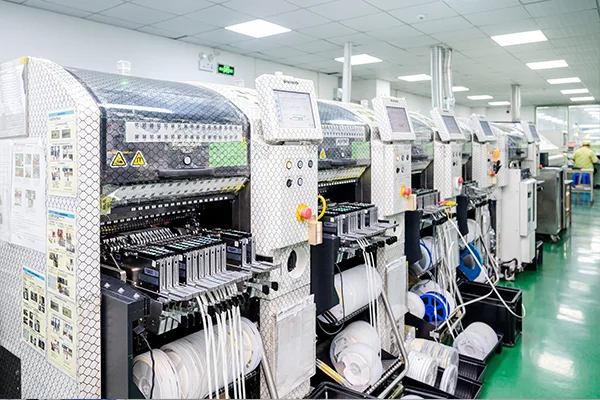
The first question is what the supplier actually controls. A manufacturer with its own factory — production floor, SMT (surface-mount technology) lines for PCBA assembly, enclosure processing, and final assembly — controls quality at every step and can adjust quickly when a project needs it. A trading company or brand-only operation coordinates other people’s factories, which adds a communication layer exactly where projects lose time. The difference shows up in sample iterations, in fault tracing, and in who can actually promise a delivery date.
Quantify the basics: factory floor area, monthly production capacity, and how long the factory has been running. A facility such as Levinko’s 3,000-square-meter Shenzhen plant with a monthly capacity of 30,000 units signals a mid-scale manufacturer sized for OEM programs — large enough for volume, small enough that your project matters. You can see our own production environment on the manufacturing page, including the SMT and assembly areas that determine whether the factory is real.
Criterion 2: Engineering Support for OEM and ODM Projects
Hardware integration consumes engineering hours, and the manufacturer decides how many. A capable supplier provides mainboard pin-definition drawings, interface protocol documents, driver packages, and calibration tools during sampling — not after the order. For deeper projects, ask who reviews your schematic questions, who tests your application on the target hardware, and whether the factory pre-configures units (auto-start settings, kiosk-mode lockdown, pre-installed applications) before shipment. These services convert a box of hardware into a deployable product.
Test the support channel early: send a technical question during the evaluation and measure the response. Manufacturers whose engineers answer directly — with specifics about SoC platforms (روكشيب, Intel), OS builds, or interface behavior — will behave the same way when your project hits a deadline. Suppliers who route every question through a salesperson will do that too. Our own OEM and ODM services page describes the engineering workflow a professional program should offer.
Criterion 3: Quality Control and Reliability Testing
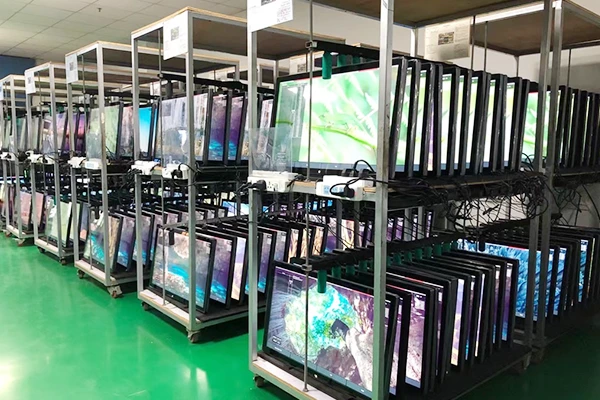
Reliability is built in testing, not promised in brochures. Ask each manufacturer to describe their quality gates in concrete terms: incoming material inspection, in-circuit and functional tests on assembled boards, touch and display calibration, and — the decisive one for commercial hardware — aging tests, where every unit runs under power for an extended burn-in period before packing. A factory that runs 24 ل 48 hours of aging per unit catches the early-life failures that otherwise surface in your lobby.
Convert claims into evidence: request the inspection criteria document, ask what percentage of units are reworked or rejected, and ask for photos or video of the test stations. A manufacturer confident in the process shows it. Also confirm component policy — whether panels are A-grade stock from primary suppliers and whether key components are traceable per batch, which matters when you need a defect investigated six months later.
Criterion 4: Certification and Compliance Track Record
The compliance baseline has two layers. First, the factory’s quality management: ISO 9001 certification indicates documented, audited processes rather than ad-hoc production. Second, the products: CE, لجنة الاتصالات الفيدرالية, and RoHS cover the major Western markets, while experience supporting UL and UKCA submissions matters for buyers with North American and UK requirements. Ask for certificate numbers you can verify, and confirm the certificates cover the exact configuration you order — size, power adapter, and wireless modules all appear on the paperwork.
For OEM projects, compliance extends to cooperation: who prepares technical files, how design changes trigger retesting, and whether the supplier has run custom configurations through certification before. A manufacturer who treats these as routine engineering tasks — rather than a favor — has done it many times, and that history is exactly what you are paying for when problems appear at customs.
Criterion 5: Customization Flexibility and Platform Approach
Most commercial projects eventually customize something — a logo, a color, an interface, a boot screen. Evaluate the manufacturer’s customization ladder: white-label branding (logo silk-screen, packaging, boot screens, pre-installed software), light customization (Pantone colors, material swaps, interface additions such as RS232/RS485/PoE/NFC), and deep customization (board-level development, enclosure tooling). Ask for typical sampling times at each level; a mature platform produces branded samples in days, light-customization samples in a week to ten days, and board-level first samples in about a month.
The deeper question is architectural: does the manufacturer run a platform — shared mainboards, consistent interface definitions, a common API across screen sizes — or a drawer of unrelated products? Platforms compound in your favor: software written once controls a 10.1-inch room panel and a 21.5-inch kiosk with the same calls, follow-on sizes need no requalification, and spare parts stay interchangeable. Levinko builds its entire line — wall-mounted tablets, POS hardware, kiosks, signage, industrial monitors — on one touch-display-and-control platform with a model-agnostic API, which is the pattern to look for. Start from the product line overview to see whether a supplier’s range is genuinely a family or just a catalog.
Criterion 6: Lead Times, MOQ, and Commercial Terms
Commercial terms reveal how a manufacturer wants to work with you. Map them explicitly:
- Lead times — standard units should ship in three to five days; light customization adds a sampling cycle; board-level projects need a realistic month-plus schedule. Ask what triggers delays and how they communicate them.
- MOQ policy — professional manufacturers support sampling and pilot batches (Levinko takes standard-product orders from one unit) and quote deep-custom MOQ case by case. Blanket high MOQs on standard hardware signal a factory organized for distributors, not projects.
- Price transparency — the sample stage is where honest pricing shows. A supplier who states the mass-production price range and its validity up front is protecting your budget; one who quotes cheap samples and “volume pricing later” is not.
- Payment and delivery terms — standard OEM terms such as T/T deposit with balance, and Incoterms from EXW through FOB to DDP, indicate experience with export projects. Confirm which terms apply before comparing quotes.
Criterion 7: After-Sales Support and RMA Process
Ask the manufacturer to narrate a field failure: a unit in a customer’s store stops responding — what happens next? Strong answers include a stated response-time commitment (24 hours is the professional standard), remote diagnosis first, and board-level spare parts shipped by courier with replacement instructions — because returning whole monitors across borders is slow and expensive. Ask about warranty length (one year is the commercial baseline), who covers freight on claims, and whether volume orders include a spare-parts allocation.
Fleet-scale buyers should also ask about firmware lifecycle: how updates are distributed (LAN OTA, USB offline updates, PC-based flashing), and whether the supplier can co-manage a dedicated update server for large deployments. The answers describe your operating cost for the next three years.
Red Flags That Should End an Evaluation
| Red Flag | What It Usually Means |
|---|---|
| No verifiable factory address or refusal to show production areas | Trading company posing as a manufacturer; quality control is indirect |
| Certificates that cannot be verified or do not match ordered configs | Compliance risk that surfaces at customs or in tenders |
| Vague answers on aging tests and QC procedures | Early-life failures will be discovered at your sites |
| Sample pricing without a mass-production price range | Budget will drift once the project is committed |
| No written interface documentation or API references | Integration hours will multiply on your side |
| Engineering questions always routed through sales | Support will bottleneck precisely when the project needs speed |
Scorecard: Comparing Manufacturers Side by Side
Build a simple weighted scorecard across the seven criteria — manufacturing depth, engineering support, QC and testing, certification, customization platform, commercial terms, and after-sales — and score each candidate on evidence received, not promises made. Request the same artifacts from every supplier (factory overview, QC process, certificate copies, sample documentation, support response test) so the comparison stays honest. Most evaluations resolve quickly once evidence replaces marketing.
Levinko is a commercial smart-display manufacturer founded in 2010, running an ISO 9001-certified 3,000-square-meter factory in Shenzhen with in-house SMT, assembly, and aging-test stations, and a monthly capacity of 30,000 units. Products carry CE, لجنة الاتصالات الفيدرالية, and RoHS certification, with engineering support available for UL and UKCA projects. If you are qualifying suppliers for a touch monitor project, introduce your project to our team — we will provide the factory details, documentation samples, and references your evaluation needs.
الأسئلة المتداولة
How do I verify a touch screen monitor manufacturer is a real factory?
Ask for the factory address and floor area, request photos or video of the SMT lines, assembly areas, and aging-test stations, and check whether the business license and ISO 9001 certificate match the same entity. Trading companies typically cannot show in-house production areas or QC stations. A factory visit or live video walkthrough settles any remaining doubt.
What certifications should a touch screen monitor manufacturer hold?
Look for ISO 9001 certification for the factory’s quality management system, and CE, لجنة الاتصالات الفيدرالية, and RoHS certificates for the products matching your exact ordered configuration. Buyers serving North America and the United Kingdom should also confirm the manufacturer has engineering experience supporting UL and UKCA submissions for custom builds.
What is a reasonable lead time for commercial touch monitors?
Standard in-stock units should ship within three to five days. Light customization — branding, colors, interface changes — typically samples in seven to ten working days. Board-level custom development takes roughly 30 ل 35 days to first samples. A manufacturer who cannot state these ranges clearly has either no platform or no process.
Why does a platform approach matter when choosing a manufacturer?
A platform means the manufacturer’s products share mainboards, interface definitions, and APIs across screen sizes. Your software team writes hardware integration code once and reuses it across the whole fleet; follow-on deployments in new sizes need no requalification; spare parts stay interchangeable. Without a platform, every new model is a new integration project.
What should a manufacturer’s RMA process include?
A professional process includes a stated response commitment — 24 hours is standard — remote diagnosis first, then couriered replacement boards or parts with replacement instructions, rather than cross-border returns of whole units. Confirm the warranty length (one year is the commercial baseline), freight responsibility on claims, and whether volume orders include a spare-parts allocation.
Should I buy touch monitors from a manufacturer or a trading company?
For OEM projects and multi-site deployments, buy from the manufacturer. Direct access to the factory shortens sample iterations, makes fault tracing possible, keeps pricing transparent from sample to volume, and puts engineering support one call away. Trading companies add a margin and a communication layer precisely where project timelines are most fragile.